

Prepared by EnormMed Pharma
A B2B Guide for Pharmaceutical Companies, Distributors, Exporters and Healthcare Brands
Introduction
Choosing the right manufacturing model is one of the most important decisions for any pharmaceutical business. Whether you are launching a new product, expanding an existing portfolio, or entering new domestic or international markets, the manufacturing partner you select can directly influence product quality, delivery timelines, regulatory compliance, and long-term business growth.
Two terms frequently used in the pharmaceutical industry are Contract Manufacturing and Third-Party Manufacturing. Although many people use these terms interchangeably, they are not always understood in the same way. Both models allow companies to outsource production to an experienced manufacturer, but the level of involvement, branding, operational control, and business objectives can differ depending on the partnership.
In this guide, EnormMed Pharma explains both manufacturing models in simple language, compares their advantages, highlights the key differences, and provides practical guidance to help pharmaceutical companies choose the approach that best fits their business goals.
What is Contract Manufacturing?
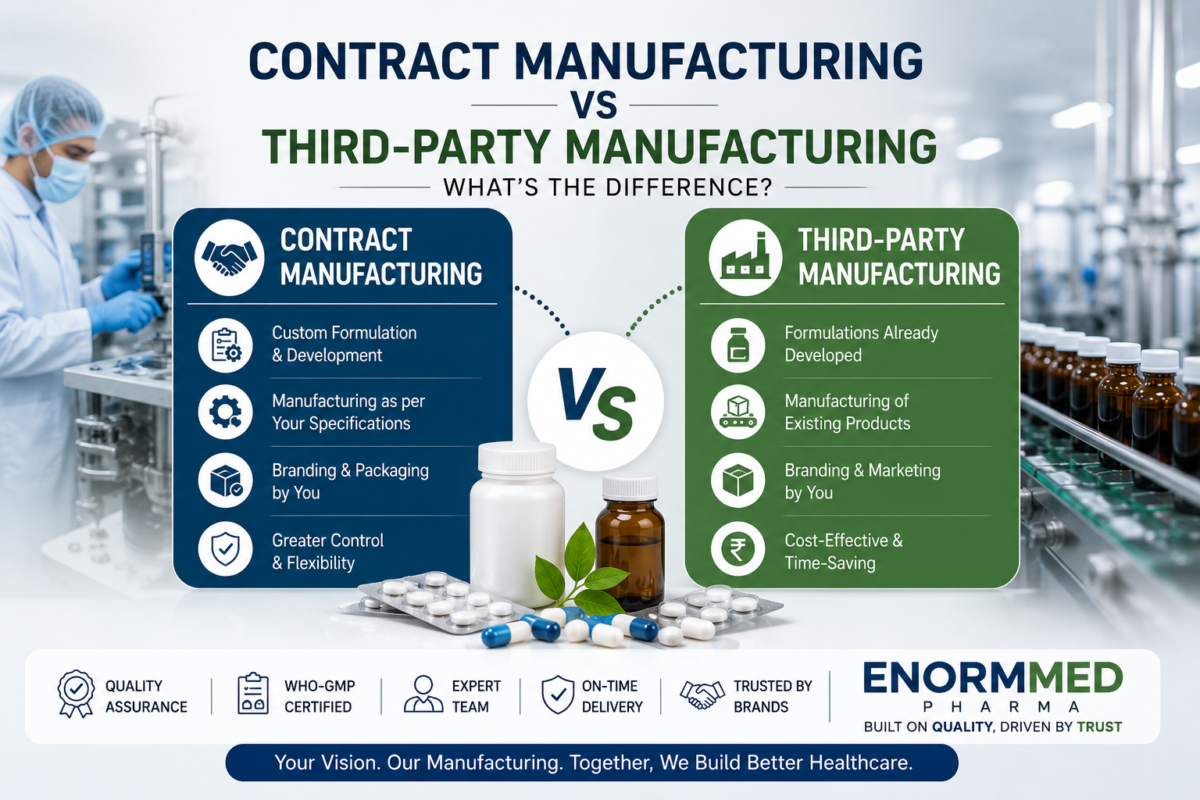
Contract manufacturing is a business arrangement in which a pharmaceutical company hires a specialized manufacturer to produce medicines according to mutually agreed specifications. The client may provide the formulation, product requirements, packaging specifications, or brand guidelines, while the manufacturer manages production under established quality systems.
This model is widely used by companies that want to expand production capacity, reduce capital investment, accelerate product launches, or access specialized manufacturing expertise without building their own manufacturing facility.
Key Characteristics of Contract Manufacturing
· Production based on agreed quality specifications.
· Suitable for companies looking to scale manufacturing efficiently.
· Supports consistent production under recognized quality systems.
· Can include formulation support, packaging, and documentation depending on project requirements.
What is Third-Party Manufacturing?
Third-party manufacturing refers to outsourcing the production of pharmaceutical products to a manufacturer who produces medicines that are marketed and sold under the client’s brand name. It is a widely adopted model for pharmaceutical companies, distributors, and startups that want to build a branded portfolio without investing in manufacturing infrastructure.
The manufacturing partner handles production while the client focuses on branding, sales, distribution, and market expansion.
Contract Manufacturing vs Third-Party Manufacturing: Key Differences
Although both business models involve outsourcing pharmaceutical production to an experienced manufacturer, they are structured differently. Understanding these differences helps businesses choose a manufacturing partnership that aligns with their commercial goals, product strategy, and long-term growth plans.
| Comparison Area | Contract Manufacturing | Third-Party Manufacturing |
| Primary Objective | Manufacture products according to agreed specifications and project requirements. | Produce products that are marketed under the client’s brand. |
| Brand Ownership | Usually the client owns the brand and product strategy. | The client markets the finished product under its own brand. |
| Business Focus | Production partnership for manufacturing support. | Brand building, distribution and market expansion. |
| Flexibility | Often tailored to project-specific manufacturing needs. | Suitable for companies expanding branded product portfolios. |
| Best For | Established pharma companies requiring manufacturing capacity. | Startups, distributors and companies building branded portfolios. |
Advantages of Contract Manufacturing
Contract manufacturing allows pharmaceutical businesses to increase production capacity without investing in expensive manufacturing infrastructure. It can improve operational efficiency while allowing companies to focus on product development, marketing, regulatory planning and commercial growth.
· Reduced capital investment in production facilities.
· Access to experienced manufacturing teams.
· Scalable production as demand grows.
· Improved operational efficiency.
· Support for long-term manufacturing partnerships.
Advantages of Third-Party Manufacturing
Third-party manufacturing is widely preferred by businesses that want to launch or expand a branded pharmaceutical portfolio without setting up their own production unit. The model enables companies to concentrate on sales, distribution and customer relationships.
· Faster product launches.
· Lower operational overhead.
· Opportunity to build a branded product portfolio.
· Supports regional and national expansion.
· Ideal for distributors and growing pharma businesses.
Which Model Should You Choose?
The right choice depends on your business objectives rather than one model being universally better than the other. Companies seeking dedicated manufacturing capabilities for specific projects may prefer contract manufacturing, while businesses focused on building and expanding branded product portfolios often find third-party manufacturing more suitable. Evaluating production capacity, quality systems, documentation, communication and long-term reliability is more important than choosing solely on cost.
How to Choose the Right Pharmaceutical Manufacturing Partner
Selecting a manufacturing partner is a long-term business decision. Beyond production capacity, buyers should evaluate quality systems, communication, scalability, documentation, and the ability to consistently deliver products that meet agreed specifications. A reliable partner contributes to business continuity and helps reduce operational risk.
10-Point Evaluation Checklist
1. Verify manufacturing certifications and compliance with applicable quality standards.
2. Review the company’s manufacturing infrastructure and production capabilities.
3. Assess quality assurance (QA) and quality control (QC) processes.
4. Confirm the range of dosage forms and packaging options available.
5. Evaluate production capacity and scalability for future growth.
6. Understand documentation and regulatory support offered.
7. Discuss production timelines and delivery commitments.
8. Review communication practices and customer support responsiveness.
9. Ask about private labeling, contract manufacturing, or third-party manufacturing services if required.
10. Look for a long-term partner rather than selecting only on price.
Common Mistakes Businesses Should Avoid
Many businesses compare manufacturers only on pricing. While cost is important, relying on it alone can lead to supply disruptions, inconsistent quality, or limited scalability. It is equally important to assess manufacturing experience, transparency, quality systems, and the ability to support your business as it grows.
Questions to Ask Before Signing a Manufacturing Agreement
· What manufacturing capabilities do you offer?
· What quality systems are followed throughout production?
· What packaging options are available?
· Can production volumes be increased as demand grows?
· What is the typical production and dispatch timeline?
· How are quality concerns or deviations managed?
Why Businesses Work with EnormMed Pharma
At EnormMed Pharma, we believe manufacturing partnerships are built on consistency, quality, and transparent communication. Our focus is to support pharmaceutical businesses with dependable manufacturing solutions, modern production practices, and responsive customer service. Whether a business is expanding an existing portfolio or introducing new products, our objective is to build long-term relationships based on trust and operational excellence.
Key Takeaways
· Choose a manufacturer based on quality, not only cost.
· Evaluate infrastructure, QA/QC, documentation, and scalability.
· Clear communication is essential for long-term success.
· Select a partner capable of supporting future business growth.
Frequently Asked Questions (FAQ)
1. What is the main difference between contract manufacturing and third-party manufacturing?
Contract manufacturing generally refers to a manufacturer producing products according to agreed project specifications, while third-party manufacturing is commonly used when products are manufactured and marketed under the client’s brand. The exact terminology may vary across businesses, so it’s important to discuss the scope of services before starting a partnership.
2. Which manufacturing model is better for a growing pharmaceutical company?
There is no universal answer. The right model depends on your business objectives, product portfolio, production requirements, and long-term growth strategy.
3. What should I look for before choosing a pharmaceutical manufacturing partner?
Evaluate manufacturing capabilities, quality systems, production capacity, documentation, communication, packaging options, and the ability to support future growth.
4. Why are quality systems important?
Strong quality systems help maintain consistent production, support regulatory compliance, reduce operational risks, and build confidence among business partners.
5. Can one manufacturing partner support multiple product categories?
Many manufacturers offer multiple dosage forms and packaging solutions. Always confirm available capabilities before finalizing a partnership.
6. How important is scalability?
A manufacturing partner should be capable of increasing production as your business grows without compromising quality or delivery commitments.
Conclusion
Choosing between contract manufacturing and third-party manufacturing is not simply a matter of selecting one model over another. The better choice depends on your company’s goals, product strategy, operational requirements, and long-term vision.
A successful manufacturing partnership is built on consistent quality, transparent communication, reliable delivery, and a shared commitment to business growth. Companies that carefully evaluate their manufacturing partners are better positioned to expand their product portfolio, strengthen customer confidence, and compete effectively in a dynamic pharmaceutical market.
At EnormMed Pharma, we believe every partnership should be based on trust, quality, and long-term collaboration. Our focus is to support pharmaceutical businesses with dependable manufacturing solutions while maintaining high standards of quality and service.
Call to Action
Looking for a reliable pharmaceutical manufacturing partner? Connect with EnormMed Pharma to discuss your manufacturing requirements, explore suitable production solutions, and learn how our team can support your business objectives.
Recommended Internal Links
· About EnormMed Pharma
· Third-Party Manufacturing Services
· Contract Manufacturing Services
· Our Manufacturing Facility
· Quality Assurance & Quality Control
· Contact Us